Best Boat Insurance for Florida Boat Owners
A good day on the water can turn expensive fast when a lower unit meets an unmarked obstruction, a storm

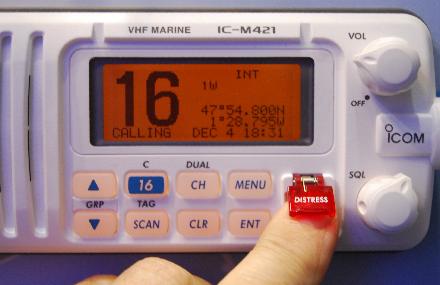
Some of the most common questions we receive from boaters include: What is an MMSI number? What is DSC? And how does it actually help me on the water?
To properly answer these questions, it is important to first understand the role of VHF marine radios. VHF radios remain the primary and most reliable means of communication on the water, allowing mariners to communicate with other vessels, harbormasters, marinas, and the U.S. Coast Guard. When combined with modern digital features such as Digital Selective Calling (DSC), a VHF radio becomes a powerful safety and emergency tool—not just a basic communication device.
Have you ever noticed that the farther offshore you travel, the more difficult it becomes to receive or transmit a clear radio signal? There is a reason for that.
Most VHF marine radios operate using what is known as a “line-of-sight” signal. In simple terms, radio transmissions travel from Point A to Point B in a straight line. This method works well for vessels operating close to shore, but it becomes increasingly unreliable as they travel farther offshore.
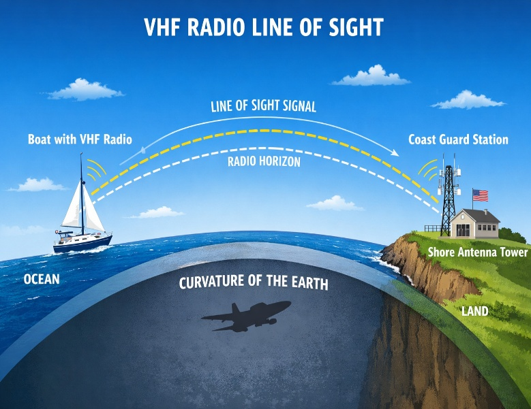
The primary limitation is the curvature of the Earth. As distance from land increases, the curvature of the Earth interferes with radio waves, often resulting in weak, garbled, or completely lost transmissions. In a life-threatening situation, seconds matter. A vessel in distress attempting to broadcast its position may lose valuable time if its transmission cannot be clearly received—potentially making the difference between a successful rescue and a tragic outcome.
To overcome these limitations, the Coast Guard addressed the problem by upgrading communication systems and integrating satellite technology, significantly improving offshore communication and emergency response capabilities.
In the early 2000s, the U.S. Coast Guard identified a critical need to reliably locate distress calls regardless of distance from shore. This led to the development and deployment of Rescue 21, an advanced maritime communication system designed to dramatically improve search-and-rescue response capabilities.
Rescue 21 enables the Coast Guard not only to receive VHF distress transmissions, but also to determine the approximate location of the transmitting vessel using a network of powerful, shore-based antennas. The system digitizes incoming radio signals and analyzes their timing and bearing data. By comparing the angle of arrival from multiple antenna sites, Rescue 21 can triangulate a vessel’s position far more accurately than legacy systems.
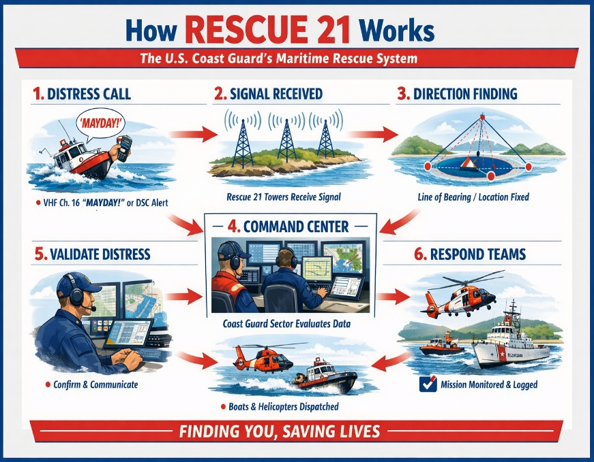
Rescue 21 technology is also integrated across Coast Guard operational assets, including small boats, cutters, fixed-wing aircraft, and helicopters. As a result, when a distress transmission is received, responding units can rapidly identify the general location of the vessel in trouble—even if the caller is unable to provide precise coordinates. Notably, this capability does not rely on the distressed vessel transmitting GPS data. This technological foundation paved the way for MMSI numbers and Digital Selective Calling (DSC). MMSI stands for Maritime Mobile Service Identity and is a unique nine-digit identification number assigned to a vessel’s radio station. It can be thought of as the maritime equivalent of a telephone number. An MMSI identifies your vessel during routine radio communications, distress calls, and digital safety signaling.
In the United States, MMSI numbers are issued and managed by the Federal Communications Commission (FCC) or by authorized private registrars for domestic, non-commercial use.
The primary advantage of having an MMSI number is the ability to provide instant vessel identification, automated distress alerts, precise location reporting, and ultimately a faster Coast Guard response. When properly configured, your MMSI information can also be displayed on Maritime Automatic Identification System (AIS) platforms, allowing other vessels and rescue authorities to see your identity, position, course, and speed. In many ways, an MMSI functions as a digital lifeline—and it remains one of the simplest, highest-impact safety upgrades a boater can make.
Digital Selective Calling (DSC) is a digital alerting system built into most modern marine VHF radios. Rather than relying solely on voice transmissions, DSC allows vessels to send automated distress alerts and routine call signals using digital data. Think of DSC as the 911 system for marine radios. It instantly transmits who you are and where you are—even if you are unable to speak.
Before DSC, distress calls relied entirely on voice communication. Poor radio technique, heavy radio traffic, stress, and language barriers often delayed or distorted the critical information needed to coordinate a rescue. DSC was designed to eliminate those obstacles.
Most modern marine VHF radios sold today are equipped with both GPS integration and a dedicated DSC distress button. When the DSC button is activated, the radio automatically transmits your MMSI number and GPS position directly to the Coast Guard and other DSC-enabled vessels. In many systems, the distress alert is broadcast on VHF Channel 70, the international DSC calling channel.
Important: For DSC to function properly, you must have both a registered MMSI number and a GPS-integrated VHF radio that is correctly connected and configured.
Beyond emergencies, DSC also offers valuable non-distress functions. Boaters can digitally “call” another vessel using its MMSI number, prompting both radios to automatically switch to an agreed-upon working channel. This reduces congestion on Channel 16 and promotes clearer, more professional radio communications.
Some boaters remain skeptical, often saying things like, “I stay close to shore,” or “I’ll just make a MAYDAY call if something happens,” or “I’ve heard it’s complicated to set up.” In reality, none of these concerns are valid. MMSI registration is free, the setup process is straightforward, and modern radios are designed to be user-friendly.
The reality is that emergencies rarely unfold calmly. When something goes wrong, it often happens quickly and under extreme stress. Elevated heart rate, adrenaline, and panic can severely impair your ability to think clearly, speak effectively, or even pick up a microphone. DSC was specifically designed for those moments—allowing critical information to be transmitted instantly, with the push of a single button.
In a serious situation, that capability may very well save your life.
Trust me, it’s worth it.
For more information, click here:
Safe Boating,
William B.
A good day on the water can turn expensive fast when a lower unit meets an unmarked obstruction, a storm
A calm morning at the ramp can make any boat look like the right boat. The real difference shows up