
Is Marine Supply Pricing Transparent? A Buyer’s Guide
Marine supply pricing is transparent only when you check the full cost. Our Florida veteran’s checklist shows how to compare the full cost before you buy.


Last Updated: November 21, 2026
Quick Summary
Affordable marine gear for center consoles means spending where failure actually hurts: safety and signaling first, then communication and maintenance. Buy in that order and the total stays reasonable while the boat gets safer and more reliable each season.
Affordable marine gear for center consoles means spending where failure actually hurts, not buying the cheapest item on the shelf.
At Boatsman’s, the standard is simple: boating is expensive, maintaining one shouldn’t have to be.
Below is a practical breakdown of affordable marine gear for center consoles, organized by budget tier and by the jobs that matter most: safety, fishing, corrosion defense, and engine care.
Budget tiers help you decide where to spend first. Safety and signaling come before comfort upgrades every time.
| Tier | Typical Spend | What Belongs Here | Priority |
|---|---|---|---|
| Essential safety | Under $60 per item | Air horn, fire extinguisher, basic signaling | Buy first |
| Core electronics and medical | $150-$210 per item | Fixed-mount VHF, marine first aid kit | Buy second |
| Fishing and deck fit-out | $35-$200 per item | Rod holders, accent lighting, deck cleaner | Buy as needed |
| Maintenance and corrosion | $40-$50 per item | Fuel water separator, livewell pump, protectant | Ongoing |
The logic is straightforward. A $21.99 air horn and a $53.99 fire extinguisher together cost less than one offshore trip’s fuel. Skip them and the savings disappear the first time a squall rolls in.
Safety gear is the one category where “affordable” and “cheap” must never mean the same thing. Federal carriage requirements apply to recreational vessels, and the U.S. Coast Guard boating safety requirements set the baseline.

The Orion 508 1 oz Boat Air Horn runs $21.99 and meets USCG requirements for boats up to 39 feet, delivering a 112-decibel blast at 10 feet and up to 12 blasts per can. Operate it in short presses, not long holds, or the valve can freeze.
The Kidde MAR110 2.5 lb ABC Marine Fire Extinguisher costs $53.99. It handles trash, wood, paper, flammable liquid, and electrical fires, mounts with a plastic strap bracket, and needs no recharge.
Best for: every center console owner building a first safety kit.
Skip if: the boat already carries in-date, inspected equivalents.
The Standard Horizon GX1410B Eclipse Series 25W Fixed Mount VHF at $201.99 is a Class D DSC radio with a separate Channel 70 receiver, a distress function that transmits vessel identification and position when connected to GPS, and an IPX8 submersible rating. See the full spec by viewing the Standard Horizon fixed-mount VHF radio.
For a backup or a smaller console, the floating handheld VHF option stays visible if it goes overboard.
The Orion Voyager Marine First Aid Kit at $161.99 organizes seven modules covering wound care, sprains, eye injuries, medications, CPR, shock, and burns, inside a floating neoprene case.
Best for: offshore runs and family boating away from quick medical help.
Skip if: the boat never leaves sight of a marina.
Center console boat accessories succeed or fail on fit. A crowded deck with the wrong hardware turns a good fishing day into a tangle of lines and bruised shins.
Rod storage is the usual first upgrade.
Deck upkeep matters just as much. The Star Brite non-skid deck cleaner and protectant keeps a working deck from turning slick.
For low-light work, the Black Oak Rock Accent Light at $38.99 draws 0.35 amps, puts out 495 raw lumens, carries an IP69K rating, and fits console, compartment, and under-gunnel lighting.

Saltwater corrosion protection for marine gear is a routine, not a product.
The practical defense is a three-step loop that costs almost nothing beyond the products you already keep aboard.
Step 1: Rinse with the right flow. Fresh water dilutes and carries away chloride film.
Step 2: Dry before you cover. Trapped moisture under a cover is a corrosion chamber.
Step 3: Treat the surfaces that face sun and spray. The 303 Marine Aerospace Protectant is a protectant of the kind used on vinyl, plastic, and rubber surfaces.
Most of the corrosion that strands a boat starts in five places, and each has a different fix.
Corrosion defense scales with what you can spend, and the cheap tier does most of the work.
Watch out: a product that claims to stop corrosion on electrical connectors is not a substitute for a clean, tight connection. Grease protects a good joint; it does not repair a corroded one.
Florida’s heat, humidity, and year-round salt exposure compress the corrosion timeline.
Hurricane season adds a specific risk: a boat that sits with standing water in the bilge or under a cover after a storm gets a concentrated corrosion bath.
None of this requires a premium product. It requires a routine you actually follow, which is the whole point of affordable marine gear: spend where failure hurts, and let discipline cover the rest.
The Sierra 118-7986-1 Fuel Water Separator Kit at $45.99 helps separate water and contaminants before they reach the engine. In Florida humidity, that protection matters on boats that sit between trips. Confirm application compatibility before installing.
The Commodore 1100 GPH Vertical Livewell Pump at $42.99 moves 1100 gallons per hour, with a 360-degree rotatable housing, anti-airlock vents, and a quick-connect motor cartridge that swaps out without disturbing the base or plumbing. A reader replacing a tired pump can check the livewell pump specifications.
Fit errors cause most returns on center console boat accessories, and the reason is that a center console is a cramped, multi-surface boat. The same rod holder that clamps cleanly to a T-top frame may not fit a leaning post, and the same pump that drops into one livewell will not fit another. Before checkout, run this checklist against the actual boat, not the catalog photo.
Clamp-on hardware is sized by outside pipe diameter, not circumference, and the two are easy to confuse. A pipe about 3.3 inches around is roughly 1.05 inches across; one about 4.1 inches around is roughly 1.315 inches across. Measure across the pipe with calipers or a tape held straight through the center, at the spot where the clamp will actually sit, because T-top frames and leaning posts can taper.
Watch out: a clamp that is one size off may tighten enough to feel secure on the bench and still slip under load in a chop. Measure twice.
Electrical accessories fail on compatibility more often than on quality. Before adding a pump, light, or radio, confirm three things.
A common pattern is a boater who upgrades a pump for more flow and then discovers the factory wiring and breaker were sized for the original unit. Check the breaker rating and wire gauge before you buy, not after.
Livewell and washdown plumbing uses specific fitting sizes and thread types, and a pump with the right flow rate can still be the wrong fit. Confirm inlet and outlet sizes, thread type, and whether the existing installation uses a cartridge-style housing or a traditional through-hull mount. Replacing a cartridge pump usually means the housing stays and only the cartridge swaps; changing housing styles means planning for hose and clamp changes too.
Fuel water separators, impellers, and filters are application-specific. Confirm the engine make, model, and year against the part listing, and confirm the filter thread and bowl style if you are reusing an existing head. A separator kit that fits one outboard family may not fit another, and the return shipping cost can exceed the part price.
A center console has limited flat mounting area, and every added item competes for it. Before ordering, decide where the item mounts, how the wire or hose reaches it, and whether the run passes near heat, fuel, or moving parts. Use grommets where wire passes through fiberglass, and leave a drip loop so water runs off the wire instead of into the connector, on a boat that sees Florida thunderstorms, that and a sealed connector are the difference between a working accessory and a corroded one.
Shipping terms matter on bulky items. At Boatsman’s, standard shipping is $10.95 on orders under $199, with free shipping on qualifying orders of $199 or more. Oversized items may carry different terms, and returns require authorization. Read the return policy, including restocking fees, before you order a large or application-specific part.
If you are unsure about a fit, contact the seller with the boat model, engine model, and a photo of the mounting location. A two-minute call beats a return, and most fit problems are solved by confirming one measurement or one part number before checkout.
Affordable marine gear for center consoles comes down to sequence. Safety first, then communication, then fit and maintenance.
Boatsman’s is a veteran-owned, Florida-focused marine supply store built by boaters, for boaters.
Start with the safety tier and work outward. Boatsman’s carries USCG-compliant signaling, marine fire suppression, fixed-mount and handheld VHF radios, corrosion protectants, and engine service parts, with fit guidance before you order.
Start with the federally required items for your vessel length: wearable life jackets for everyone aboard, a throwable flotation device on boats 16 feet and longer, a fire extinguisher, sound-signaling device, visual distress signals for coastal waters, and navigation lights. Then add practical gear like a first aid kit and a fixed-mount VHF radio with DSC. The Orion 508 air horn meets USCG requirements for boats up to 39 feet, and the Kidde MAR110 covers Class A, B, and C fires. Confirm current requirements with the US Coast Guard before you head out.
Prioritize items that solve a problem you actually have on the water. Accent lighting for compartments and under-gunnel areas runs under $40 and can help with visibility during early mornings and night runs. Clamp-on rod holders add storage without drilling into a T-top or hard top. A fuel water separator kit protects the engine from moisture that Florida humidity and rain push into the fuel system. Spend first on safety and engine protection, then add fishing conveniences as your budget allows.
Rinse metal hardware, rod holders, and electronics housings with fresh water after every trip, and dry them before storage. Look for gear rated for marine exposure, such as IP69K-rated lights or IPX8-rated radios, because those ratings reflect tested resistance to water intrusion. Keep stainless fasteners and aluminum clamps clean and free of trapped salt, and inspect them monthly. Corrosion protection for marine gear is mostly about routine rinsing and choosing components built for the environment in the first place.
Measure before you order. Clamp-on rod holders are sized by outside pipe diameter, so check whether your T-top or hard top tubing is 1.050 inches or 1.315 inches. Livewell pumps are matched to flow rate and voltage, and fuel water separator kits must match your engine and filter system. Review the product listing, confirm compatibility with your engine or layout, and contact the retailer before ordering if anything is unclear. Returns usually require authorization, so getting fit right the first time saves hassle.
Marine supply pricing is transparent only when you check the full cost. Our Florida veteran’s checklist shows how to compare the full cost before you buy.
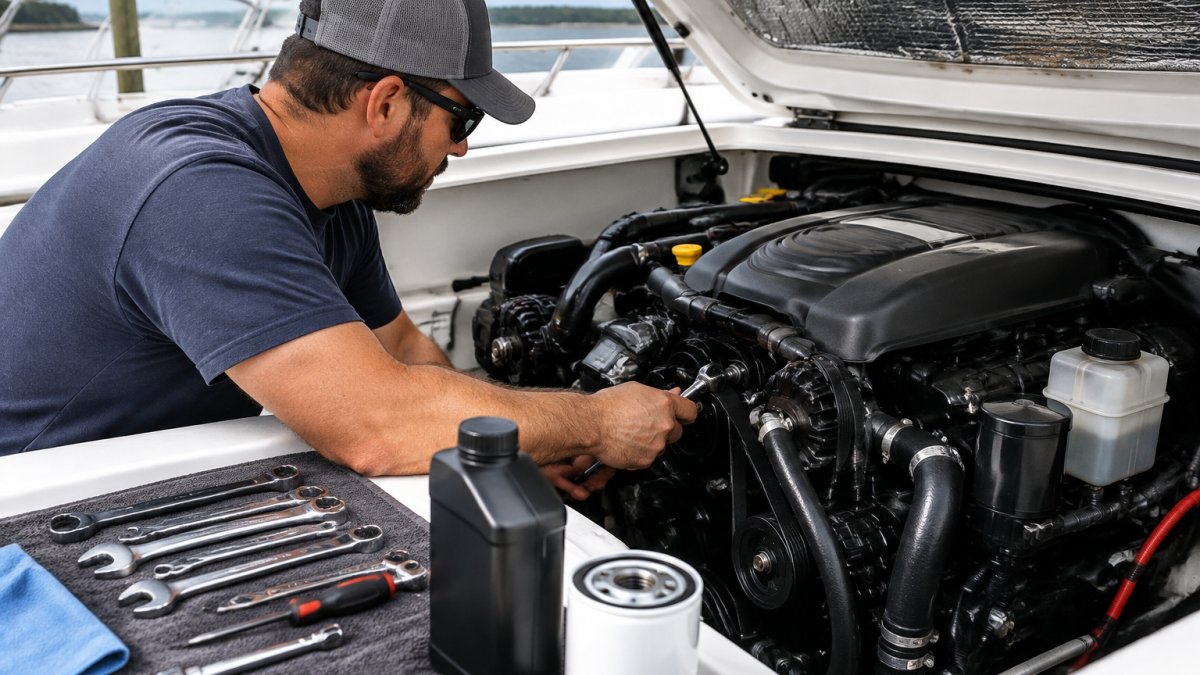
Boat engine maintenance keeps your outboard running in Florida saltwater. Learn the 8 tasks, service intervals, and flushing steps that prevent failures.