
Best Boat Insurance for Florida Boat Owners
A good day on the water can turn expensive fast when a lower unit meets an unmarked obstruction, a storm
More people today are buying used boats over purchasing brand new ones. But not getting a survey done BEFORE the purchase could cost you thousands in unforeseen repairs. A pre-purchase survey is where a boat’s good looks meet its real condition. Fresh vinyl, a shiny hull, and a clean bilge can make a strong first impression, but they do not tell you whether the stringers are sound, the engines are healthy, or the safety systems are ready for a long run offshore. This boat survey preparation guide helps buyers show up organized, ask better questions, and get the most useful report possible.
A survey is not a pass-or-fail inspection, and it is not a warranty. It is a professional snapshot of the vessel on that day, based on accessible areas and the scope of work you request. Good preparation helps the surveyor spend time evaluating the boat instead of tracking down paperwork, keys, batteries, or a lift operator.
Before preparing the boat, make sure you have hired the right professional and agreed on what will be inspected. For most used boats, a condition and value survey is the foundation. It evaluates the vessel’s overall condition, construction, installed systems, safety equipment, and fair market value. Lenders and insurers often require one, especially for older boats or higher-value purchases.
For a powerboat, add a separate engine survey from a qualified marine mechanic or engine technician. A hull surveyor may note visible engine concerns, but they are not necessarily performing diagnostics, compression testing, computer scans, or detailed mechanical evaluation. On an outboard-powered center console, that engine inspection can be as important as the hull survey. On an inboard diesel cruiser, it is essential.
Plan for a sea trial and haul-out whenever practical. A sea trial lets the surveyor observe handling, steering, temperatures, charging, vibration, electronics, and wide-open-throttle performance. The haul-out exposes the bottom, running gear, through-hulls, trim tabs, transducers, and lower units. Skipping either can save money up front, but it also leaves meaningful blind spots.
A seller should have documents available before the appointment. As a buyer, ask for them early and compare what you receive with what is physically on the boat. Missing records do not automatically mean a neglected vessel, particularly with older Florida boats that have changed hands several times. Still, a thin paper trail should affect both your questions and your negotiating position.
Create a simple file with the documents that matter most:
Check the hull identification number on the starboard transom or other assigned location against the title, registration, and purchase agreement. On documented vessels, compare the official number as well. A mismatch is not a small clerical detail to sort out later.
Also ask whether the boat has ever been grounded, sunk, struck, storm-damaged, or repaired after an insurance claim. Honest disclosure matters. A well-repaired incident is not always a reason to walk away, but undisclosed damage is a reason to slow down and investigate.
The best boat survey preparation guide is simple on this point: do not let the vessel be staged like a showroom display. The surveyor needs access to machinery spaces, bilges, lockers, batteries, electrical panels, under-deck areas, and safety gear. Personal items should be removed from storage compartments, and loose gear should be secured before the sea trial.
The boat should be in the water, fueled sufficiently for a meaningful sea trial, and connected to shore power if applicable. Batteries should be charged. Every key, fob, remote, hatch latch, and cabin lock should be available. If the seller says a system has not been used recently, ask that it be tested before survey day rather than accepting a guess.
For trailer boats, confirm that the trailer is safe and available if a haul-out or ramp inspection is planned. The trailer deserves attention too. Tires, bearings, bunks, brakes, lights, coupler condition, and the winch can add real cost after closing. A clean trailer is nice; a trailer with serviceable brakes and intact frame members is better.
Avoid having the boat freshly detailed in a way that hides clues. A clean bilge is reasonable, but wet paint, heavy deodorizer, newly installed carpet, or sealant applied right before the inspection should prompt questions. The goal is not to assume the worst. It is to see the boat honestly.
A surveyor will test accessible systems, but the buyer should still have a practical walkthrough with the seller. Turn equipment on one item at a time and note what works, what does not, and what requires more diagnosis. This reduces surprises and gives you a clear list to discuss during the survey.
Start at the helm. Check navigation lights, horn, bilge blower, wipers, trim tabs, gauges, switches, chartplotter, VHF, stereo, compass, and steering. Confirm that electronics power up, but remember that a powered screen is not proof that a radar, sonar, antenna, or GPS receiver is performing correctly. Testing them on the water is more meaningful.
Below deck, run fresh water at each fixture, operate the head, test shower sump pumps, inspect the water heater, and cycle the refrigerator and air conditioning if fitted. Look for leaks at fittings, drains, and through-hulls. On a boat with a generator, confirm it starts, carries a load, and supplies power where expected.
At the engines, inspect before startup. Look for corrosion, oil leaks, cracked hoses, loose wiring, fuel odors, and signs of water intrusion. Ask the seller not to warm the engines before you arrive. A cold start can reveal hard starting, smoke, alarms, or rough idle that a warmed-up engine may hide. This is especially useful with older gas inboards and high-hour outboards.
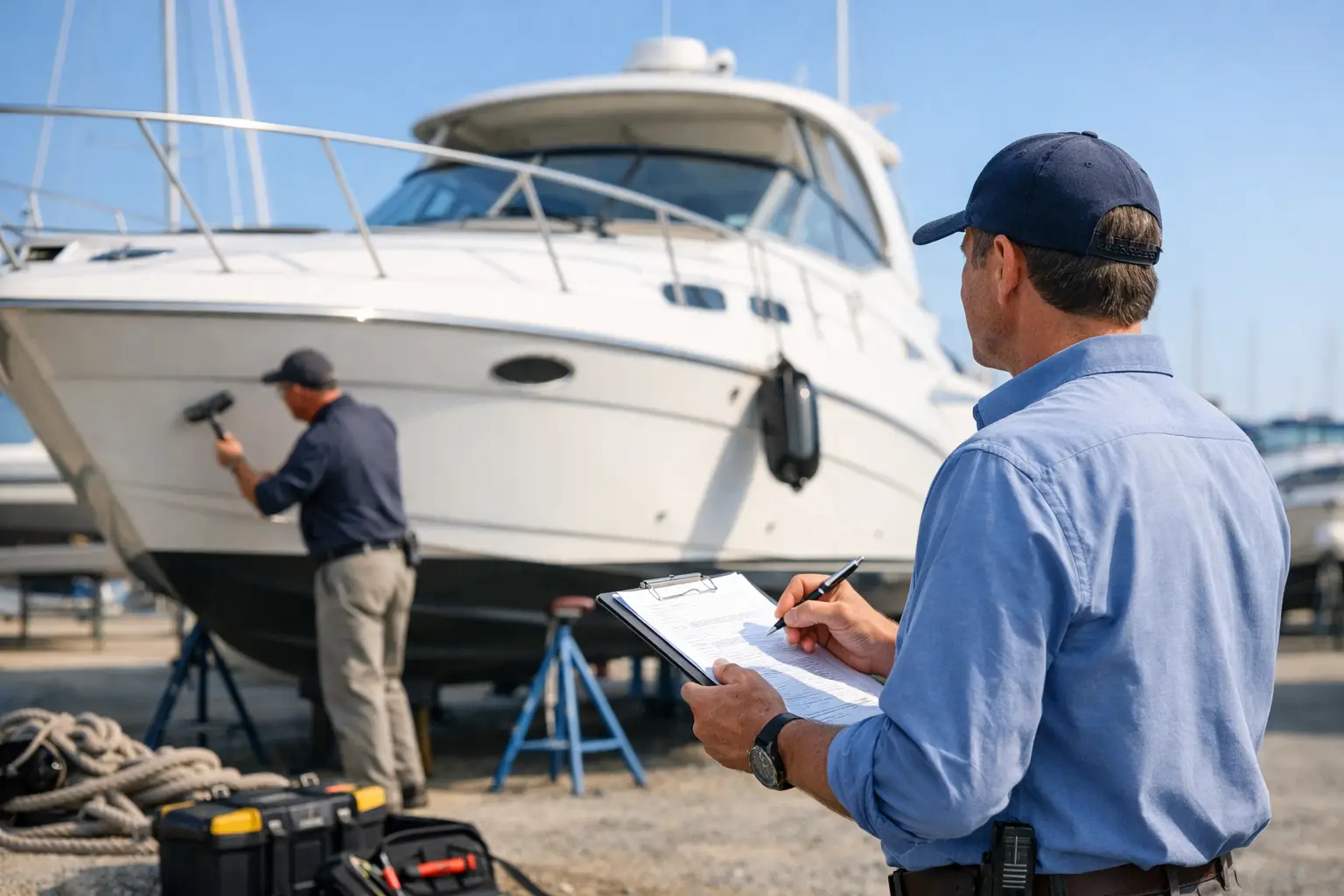
The haul-out is one of the most valuable parts of a pre-purchase survey. Schedule it with the marina or boatyard well in advance, and confirm who pays the lift fee, pressure washing, blocking, and relaunch. Get the timing right so the surveyor can examine the bottom before marine growth dries or a pressure washer removes useful evidence.
The surveyor will look for blisters, hull damage, poor repairs, moisture concerns, worn bottom paint, damaged chines, and signs of grounding. They will inspect propellers, shafts, struts, rudders, trim tabs, intakes, anodes, and through-hulls as access allows. For sterndrives and outboards, lower-unit condition and propeller damage can provide clues about how the boat has been run.
Do not be alarmed by every cosmetic scrape or patch of worn antifouling paint. Boats that live in saltwater earn a few marks. What matters is the pattern: neglected anodes, deeply pitted metal, loose running gear, cracked through-hulls, or repairs that do not match the surrounding hull deserve closer attention.
Be there if you can. You will learn more in a few hours alongside a skilled surveyor than you will from reading a report alone. Bring a notebook, take photos when permitted, and write down questions as they come up. Let the surveyor work, though. Constant interruptions can break their inspection flow and waste the time you are paying for.
Ask practical questions such as: Is this a safety issue, a maintenance item, or a negotiating item? What should be repaired before use? What can wait until the next service interval? Is this typical for a boat of this age and type? The answers help separate normal ownership costs from legitimate deal breakers.
A surveyor may use terms such as “recommend repair,” “monitor,” or “further evaluation.” Take those distinctions seriously. “Further evaluation” usually means another specialist should inspect the issue before you release your purchase contingency. If the report identifies structural concerns, fuel-system problems, significant moisture readings, or corrosion in critical systems, get clarity before negotiating only on price.
No used boat is perfect. A realistic report may include expired flares, tired batteries, outdated fire extinguishers, a weak bilge pump, corroded terminals, or service items approaching their due date. Those are normal costs of ownership and can often be handled with a focused repair allowance.
The bigger question is whether the boat’s condition, price, and intended use still line up. A family cruising boat with a questionable fuel system is a different risk than a bay boat needing new cockpit speakers. If you plan to run offshore, fish hard, or keep the boat in saltwater year-round, be stricter about structural integrity, power reliability, electrical protection, and safety gear.
Use the survey report to request repairs, negotiate the purchase price, or walk away if the issues change the value of the deal. Do not pressure a surveyor to tell you whether to buy the boat. Their job is to report condition. Your job is to decide whether that condition fits your budget and the way you want to spend time on the water.
A well-prepared survey day does more than protect your purchase. It gives you a realistic first maintenance plan, so when the keys are in your hand, you can focus on the next calm morning, a full fuel tank, and a boat ready to leave the dock with confidence.
Safe boating,
William B.
A good day on the water can turn expensive fast when a lower unit meets an unmarked obstruction, a storm
A calm morning at the ramp can make any boat look like the right boat. The real difference shows up