
Is Marine Supply Pricing Transparent? A Buyer’s Guide
Marine supply pricing is transparent only when you check the full cost. Our Florida veteran’s checklist shows how to compare the full cost before you buy.


Last Updated: November 1, 2026
Quick Summary
For most small fishing boats in the 16 to 24 foot range, the best compact bilge pump is a 500 to 800 GPH submersible model with a low-profile body, a 3/4-inch discharge, and reliable automatic switching. Size up within that range if you keep the boat in the water year-round, and run a manual backup on a separate circuit.
Finding the best compact bilge pump for a small fishing boat comes down to three things: it has to fit the space you actually have, it has to move enough water for your hull, and it has to keep working after months of salt, heat, and humidity. At Boatsman’s, we’ve spent years helping Florida boaters sort through those trade-offs, and the short answer is that most small fishing boats in the 16 to 24 foot range are well served by a 500 to 800 GPH submersible pump with a low-profile body and reliable automatic switching.
Here’s the quick version before we get into the details:
| Pump | Rated Flow | Activation | Hose Size | Best For |
|---|---|---|---|---|
| Johnson Pump 400 GPH Barbed Port | 400 GPH | Manual | 3/4 in. | Tightest budgets and smallest bilges |
| Johnson Aqua Void 500 GPH Automatic | 500 GPH | Switchless | 3/4 in. | Low-profile automatic fit |
| Johnson Aqua Void 800 GPH | 800 GPH | Manual | 3/4 in. | Value upgrade with cartridge service |
| T-H Marine HYDRA 800 GPH Cartridge | 800 GPH | Manual | 3/4 in. | Anti-airlock reliability |
| Johnson Aqua Void Ultima Combo 800 GPH | 800 GPH | Electronic switch | 3/4 in. | All-in-one automatic package |
| T-H Marine HYDRA Automatic 800 GPH | 800 GPH | Float switch | 3/4 in. | Built-in Sure-Start float switch |
| Johnson 1250 GPH Ultima Combo | 1250 GPH | Electronic switch | 1-1/8 in. | Larger hulls needing more capacity |
Below, we’ll walk through sizing, switching, installation, and the maintenance habits that keep a pump alive in a Florida bilge.
Bilge pump capacity is measured in gallons per hour, or GPH, and it describes how much water a pump can move under ideal conditions.
The mistake we see most often is buying on the advertised number alone. A pump rated at 800 GPH is tested at the discharge height the manufacturer specifies, usually measured straight out with no rise in the hose.
A practical sizing approach for a small fishing boat:
The U.S.
An automatic bilge pump for a small boat comes in two main flavors: switchless pumps that sense water electronically, and pumps paired with a separate float switch. Both remove water without you flipping a breaker, but they fail in different ways.
Switchless automatic pumps monitor the motor’s current draw or use electronic sensors to detect water.
Float switch setups use a physical float that rises with the water and triggers the pump.
Which is better? For a tight bilge where every inch of height counts, a switchless pump wins on fit. For easy servicing and predictable behavior, a float switch is hard to beat.
Compact fit is where most small fishing boat owners get stuck. A center console’s bilge can be a narrow, awkward space under the deck, and a pump that’s an inch too tall simply won’t sit where the water collects. Here are the options we’d point you toward, starting with the most compact.
Our pick for the tightest spaces. The Aqua Void 500 offers an industry-first quick-change motor connection and a reinforced click-in basket that simplifies installation, cleaning, and inspection, and its single-handed access suits tight bilge spaces. If your bilge is shallow and you want automatic operation without adding a separate switch, start here. You can check the Aqua Void 500 automatic pump in our catalog.
The budget option that still holds up. At 400 GPH with a 3/4-inch barbed port and a max height of about 4 inches, it fits small, shallow bilges and keeps the cost down. It’s manual, so you’ll pair it with a switch or run it off a helm switch. Best for a first boat or a secondary pump on a small skiff.
When bilge height is the real constraint, a low-profile non-automatic pump like the Whale Supersub fits where taller pumps won’t. It’s manual, so plan on a float switch or a helm switch, but the shallow body lets you mount it right at the lowest point. You can view the Whale Supersub low-profile pump to compare dimensions against your bilge.
A value upgrade for boats that need more capacity without more bulk. Same compact body and cartridge service as the 500, but rated at 800 GPH with a 3/4-inch connection and about 3.7 amps. Good middle ground for an 18 to 22 foot fishing boat.
Built around an anti-airlock design that helps the pump restart even when air is in the line, plus a 316 stainless steel motor shaft and a dual-lock cartridge for quick motor removal. It includes straight and 90-degree outlets, a backflow restrictor, and a flat seal.
Johnson Pump 400 GPH 12V Bilge Pump – Barbed Port →
Both bundle automatic switching into the pump. The Ultima Combo pairs the Aqua Void body with an electronic Ultima Switch, while the HYDRA Automatic uses an integrated Sure-Start float switch with an external test knob.
For larger fishing boats or anyone who wants more capacity, the 1250 GPH Ultima Combo steps up to a 1-1/8-inch hose and includes the electronic Ultima Switch for automatic operation.
A bilge pump float switch is the component that decides when the pump runs, and choosing the right type prevents both false starts and missed floods.
For most small fishing boats, we’d pair a manual pump with a separate electronic or mechanical switch so you can service each part independently. If you want to add a switch to an existing pump, you can look at the Johnson float switch we carry and match its amperage rating to your pump.
Watch out: mounting a float switch where it can’t rise freely, or wiring it without an inline fuse, is the most common cause of a pump that either never runs or runs until the battery dies.
Bilge pump installation on a small boat succeeds or fails on three details: mounting location, hose routing, and wiring. Get those right and the pump will outlast the boat’s next owner.

Location. Mount the pump at the lowest point of the bilge where water actually collects, on a solid base, with the strainer clear of the hull.
Hose and fittings. Match the discharge hose to the pump’s outlet, 3/4 inch for most compact pumps and 1-1/8 inch for the larger 1250. Keep the run short and avoid loops where water can sit. Secure every connection with stainless hose clamps. For the wiring run, use marine-grade cable rather than automotive wire.
Wiring. Run the pump through a fuse or breaker sized to the pump’s rating, use marine-grade crimped connections, and keep splices above the highest water line.
Advertised GPH is a laboratory number. Real-world flow is what you get after a season of salt, sand, and fishing line, and it’s almost always lower. The fix isn’t a bigger pump; it’s a maintenance routine.
The cartridge designs on the Aqua Void and HYDRA pumps make this easier, with a quick-change motor connection and a removable nozzle that allow service without disconnecting the hose.
The best compact bilge pump for a small fishing boat is the one that fits your bilge, matches your hull’s capacity needs, and switches on reliably without you thinking about it.
At Boatsman’s, we believe boating is expensive, but maintaining one shouldn’t have to be. Our catalog is built around affordable marine gear, and the products recommended here are available at Boatsmans.com.
Most small fishing boats in the 16 to 22 foot range do fine with a compact pump in the 500 to 800 GPH class. Match the pump to the worst case you expect, not the average day: a livewell overflow, a washdown, or spray coming over the bow. A 400 GPH pump suits a small skiff with a shallow bilge, while an 800 GPH unit gives more margin on a boat that sees rain and washdown. Check the outlet hose size too, since a 3/4 inch hose limits what the pump can actually move.
Yes, for most boats kept in the water. An automatic bilge pump for a small boat runs without you on board, which matters during Florida summer thunderstorms and when the boat sits at the dock for weeks. Switchless models like the Aqua Void automatic run without a separate float switch, while combo units pair a pump with an electronic switch. The trade-off is cost and a small standby draw. If your boat lives on a trailer and you check it often, a manual pump with a separate float switch can be enough.
Fill the bilge with a hose until the water reaches the switch, then watch whether the pump starts and stops on its own. On pumps with an external test knob, like the HYDRA automatic, turn the knob to confirm the motor runs. Listen for a steady motor note and check that water leaves the thru-hull fitting. Test the float switch separately by lifting it by hand if it is a mechanical type. Run this check before every trip and again after any heavy rain.
It can, but check the amp draw first. Compact 12V pumps like the 400 GPH and 800 GPH models will run from a portable 12V battery for short jobs. Size the fuse to the pump, typically 3A to 5A, and use tinned wire with a proper connection. A portable setup is a reasonable emergency backup, but it is not a substitute for a hard-wired pump with its own fused circuit on the boat.
A backup pump is cheap insurance on any boat that spends time offshore or moored in the water. The usual approach is a second compact pump mounted slightly higher than the primary, wired to its own fuse and switch. If the main pump clogs or its float switch sticks, the backup takes over before water reaches the floorboards. On a small fishing boat, a 500 to 800 GPH backup adds little weight and fits in most bilges alongside the primary unit.
The real challenge isn’t picking a pump; it’s picking the one that fits your specific bilge and keeps working through a Florida summer. Boatsman’s was founded by a retired Coast Guard veteran who has spent a career on the water, and we stock the compact pumps, float switches, and marine-grade wiring that get the job done without overspending. Get started with Boatsman’s and equip your boat with a bilge system you can trust.
Marine supply pricing is transparent only when you check the full cost. Our Florida veteran’s checklist shows how to compare the full cost before you buy.
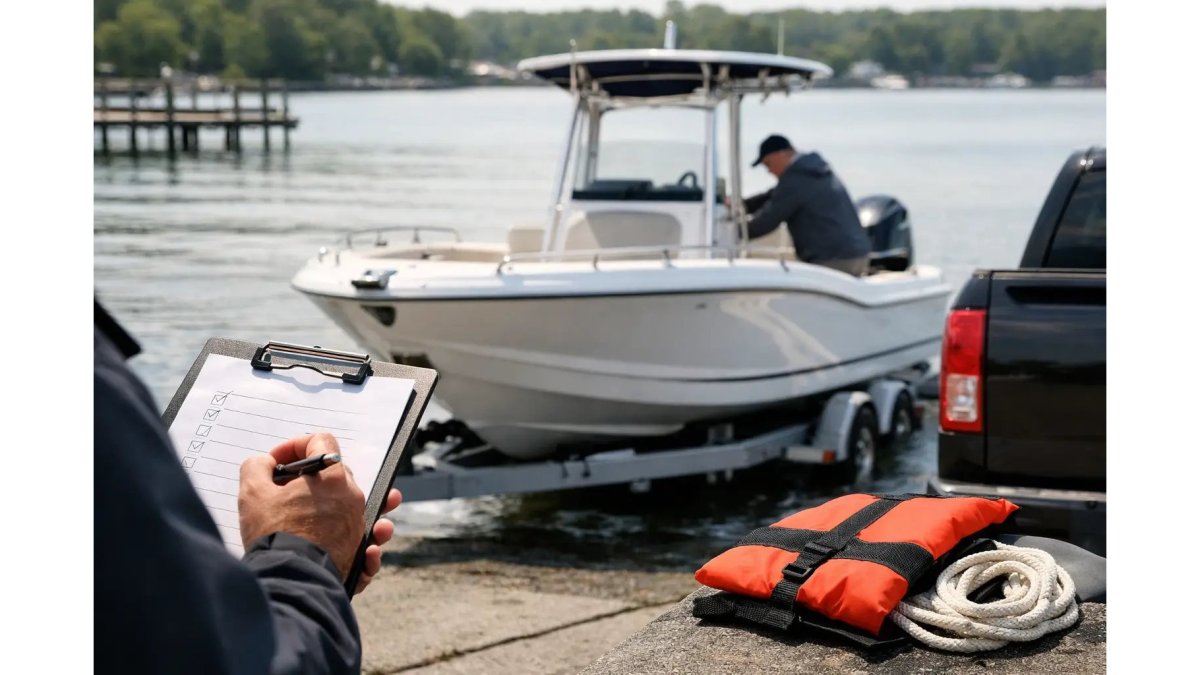
Affordable marine gear for center consoles starts with safety, lighting, and corrosion protection. Compare real prices and find gear that fits your layout.