
Is Marine Supply Pricing Transparent? A Buyer’s Guide
Marine supply pricing is transparent only when you check the full cost. Our Florida veteran’s checklist shows how to compare the full cost before you buy.


Last Updated: November 10, 2026
Quick Summary
Choosing the right marine parts online starts with buying by part number, not by picture. Write down your engine serial number, pull the parts diagram for that exact serial range, and search the part number rather than a description. This ten-minute compatibility check prevents most fitment returns.
Most wrong-part orders don’t come from a bad seller. They come from a missing number.
Choosing the right marine parts online starts with one habit: buy by part number, not by picture.
At Boatsman’s, we see this play out often with Florida boaters.
An online catalog isn’t a shelf you compare by eye. It’s a lookup table, and it only works when you feed it the right inputs.
Boat parts compatibility is the process of matching a part to your specific engine or hull using the manufacturer’s own identification numbers, not visual similarity. The check takes about ten minutes and prevents most fitment returns.

Run it in this order:
A parts diagram is an exploded drawing with numbered callouts tied to a list. The list is the real document. Read the callout number, find its row, and confirm the part number, quantity, and any serial-number notes.
Manufacturers often list two or three part numbers for one drawing position because the part changed mid-production. The notes column tells you which one applies to your serial range. Skip it and you’ll order the version that fits somebody else’s engine.
A boat parts catalog is only as good as the filters you apply. Start with engine family and serial range, then narrow by assembly, then by part number.
Watch out: catalogs that let you search by boat length or model name alone are inviting a guess. Hull length tells you nothing about the powerhead on the transom.
Filters worth using every time:
If you want a broader walkthrough of buying supplies affordably without cutting corners, our guide to buying marine supplies online on a budget covers the cost side in more detail.
OEM boat parts are built to the engine manufacturer’s specification and sold under its part number. Aftermarket parts are produced by independent manufacturers to fit the same application. Neither is automatically better.
| Situation | OEM | Aftermarket |
|---|---|---|
| Warranty claim or covered repair | Required | Usually voids coverage |
| Critical fuel or ignition components | Safest default | Only with a known cross-reference |
| Routine maintenance items | Fine | Often good value |
| Obsolete or discontinued parts | Unavailable | Only option |
| Cosmetic and accessory items | Optional | Usually fine |
Our honest take: for anything metering fuel or controlling spark, pay for the OEM part or a reputable aftermarket brand with a published cross-reference. For filters, anodes, and hardware, aftermarket is a reasonable call.
Marine engine parts online don’t sort into one category. Outboards, sterndrives, and inboards each carry their own numbering systems, and mixing them up is the single most common ordering error we see. The fix isn’t a better search bar, it’s knowing which identifier each engine family expects.
Outboards are the most frequently ordered and the most frequently returned, mostly because owners order by horsepower and ignore the serial break. Parts change mid-production without a model-year change, so a 2019 200hp and a 2020 200hp can share a cowling and share nothing under it.
What to have in hand before you search:
Fuel system components deserve extra care. We stock the Sierra 118-7968 fuel water separator filter at $19.99 and the Sierra 118-7982-1 fuel water separator kit at $39.99 for a complete service swap. The Arco Marine replacement outboard starter for Yamaha 200-300hp shows how a listing should read: part number, tooth count, and application stated up front.
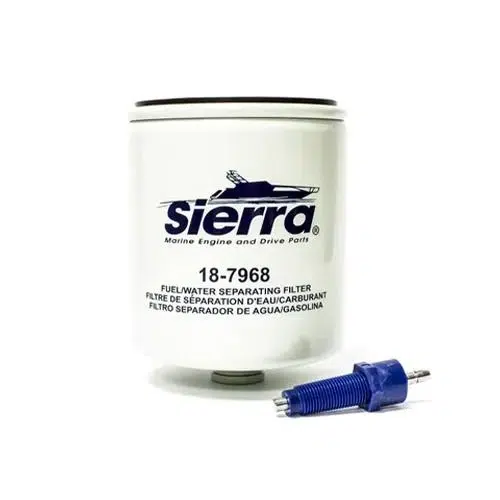
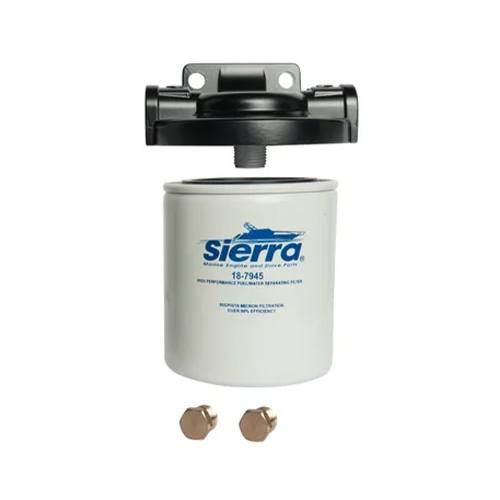
For fuel line replacement, an EPA-compliant hose is not optional. The Trident Marine barrier-lined outboard fuel line hose is built for that requirement and names the compliance standard.
A sterndrive is two machines bolted together, an engine and a drive, and each has its own serial number and parts catalog. Ordering an engine part with the drive’s serial number, or vice versa, is a common and expensive mistake.
Bellows, gimbal bearings, and trim components are the highest-risk items because they’re maintenance-interval parts that change across drive generations. Pull the drive serial, then the diagram for that serial range, then the part number.
Inboards are usually marinized versions of a base engine, a GM block, a Cummins, a Yanmar, and the catalog splits accordingly. Some components are base-engine parts; others are marine-conversion parts (manifolds, raw-water pumps, heat exchangers, mounts) that carry the marinizer’s part number.
Exhaust manifolds and risers are the classic inboard ordering error: they look interchangeable across years and aren’t. Order by the marinizer’s part number for your engine serial range.
Instead of treating every part the same, apply the criteria that matter for that category:
| Category | Primary identifier | What to verify before buying |
|---|---|---|
| Engine (fuel, ignition, cooling) | Engine serial number | OEM vs. aftermarket cross-reference; ignition protection rating |
| Electrical | Engine or hull serial; system voltage | Tinned copper wire; ABYC-compliant ratings; ignition-protected in engine spaces |
| Fuel system | Engine serial number | EPA-compliant hose; USCG Type A1/A2 for fill and vent; ethanol compatibility |
| Steering | Helm and engine/drive serial | Cable length and type; compatibility with helm and engine |
| Safety equipment | Vessel length and use | USCG requirements; Florida FWC rules; expiration dates on signals |
| Comfort and accessories | Hull and mounting dimensions | 316 stainless where exposed; UV-stable materials |
Watch out: for steering, safety, and fuel components, a part that physically fits but isn’t rated for the application is a safety problem, not a fitment problem. Verify the rating, not just the threads.
For a broader walkthrough of buying supplies affordably without cutting corners, our guide to buying marine supplies online on a budget covers the cost side in more detail.
Three things decide whether an online part survives its first season: what it’s made of, whether it’s genuine, and what it actually costs to get it to your transom. Most buying guides skip all three. Here’s the working version.
“Marine-grade” is a marketing phrase, not a specification. What matters is the alloy, the coating, and the rating, and whether the listing states them.
Watch out: a listing that describes a part as “corrosion resistant” without naming the alloy or coating is telling you nothing you can verify.
Counterfeit marine parts are a real problem in safety-critical categories, fuel components, ignition, steering, and electrical. The failure mode isn’t usually obvious at unboxing; it’s a part that fits but doesn’t meet the spec.
A practical screening routine:
For safety-critical components, fuel pumps, ignition modules, steering cables, battery switches, the counterfeit risk is worth paying to avoid.
The sticker price is the smallest part of the decision when a repair is stalled. Landed cost includes:
A part that saves a few dollars but ships slowly from a distant warehouse can cost more in lost time than the savings. For maintenance items you can plan around, slow and cheap is fine. For a part keeping the boat off the water, verified fitment and fast delivery are worth more than the lowest price.
If you want practical tactics for trimming cost without gambling on quality, read our guide on how to save money on boat parts.
Confirm three things before checkout: the return window, who pays return freight, and whether the part carries a manufacturer warranty or a seller warranty.
Fitment guarantees are worth reading closely. A guarantee covering “wrong part shipped” is not the same as one covering “part didn’t fit my engine.” Get the second in writing for a high-dollar assembly.
A short pre-purchase checklist:
If you’re still deciding whether online ordering is reliable in this state, our article on buying marine parts online in Florida addresses that directly.
The pattern holds across every part category. Identify by serial number, confirm on the diagram, cross-reference the number, then check the return terms.
Boatsman’s exists to make that easier for Florida boaters. We’re veteran-owned, and we aim to keep maintenance parts affordable. Boating is expensive.
Start with your engine’s serial number, then shop all marine supplies and build the order around verified part numbers.
The gap between a smooth repair and a wasted weekend usually comes down to ten minutes of verification before checkout. Boatsman’s carries the fuel system parts, starters, and maintenance supplies that keep Florida boats running, backed by a catalog built on real maritime experience. Get started with Boatsman’s and order the part that actually fits your engine.
Start with the engine, not the hull. Write down the manufacturer, model, horsepower, and serial number from the plate on the outboard or sterndrive, then match those numbers against the seller’s parts diagram. The serial number narrows production years and mid-year changes that a model name alone will miss. Confirm the part number in the listing matches the diagram before you order, and keep a photo of the old part and its label for comparison.
OEM boat parts come from the engine manufacturer and match factory fit and finish, which matters for warranty work and complex assemblies. Aftermarket parts from established brands often cost less and perform well for routine service items like filters and impellers. For a boat still under warranty, check the manufacturer’s terms before substituting. For older engines past warranty, a quality aftermarket part is a reasonable choice if the part number cross-references correctly.
Cross-check three things: the part number in the listing, the application chart or diagram for your engine’s serial number range, and the physical details such as thread size, mounting pattern, and connector type. If the listing shows a Sierra number like 118-7968, confirm that number against the engine maker’s cross-reference. When a listing is vague about fitment, ask the seller for the application data in writing before you buy.
Buy from a seller that publishes part numbers, application data, and a clear return policy, and that answers fitment questions before the sale. Boatsman’s lists part numbers on its product pages, so you can verify the number against your engine’s diagram. Avoid listings that show only a photo and a generic title with no number, and confirm shipping timelines and return windows before checkout.
Have your engine manufacturer, model, horsepower, and serial number ready, plus the old part number if it is legible. Note the part’s location and any adjacent components that may need replacing at the same time, such as gaskets or O-rings. Confirm the seller’s return window and whether the part is returnable once installed. A photo of the failed part and its mounting area helps the seller confirm the match before shipping.
Buy from established retailers rather than unfamiliar marketplace sellers, and check that the packaging carries the manufacturer’s branding and part number. Counterfeit filters and electrical components are the most common problem because they are easy to copy and hard to inspect. Compare the price against the normal range for that part; a steep discount on a branded item is a warning sign. Inspect the part on arrival before installation.
Marine supply pricing is transparent only when you check the full cost. Our Florida veteran’s checklist shows how to compare the full cost before you buy.
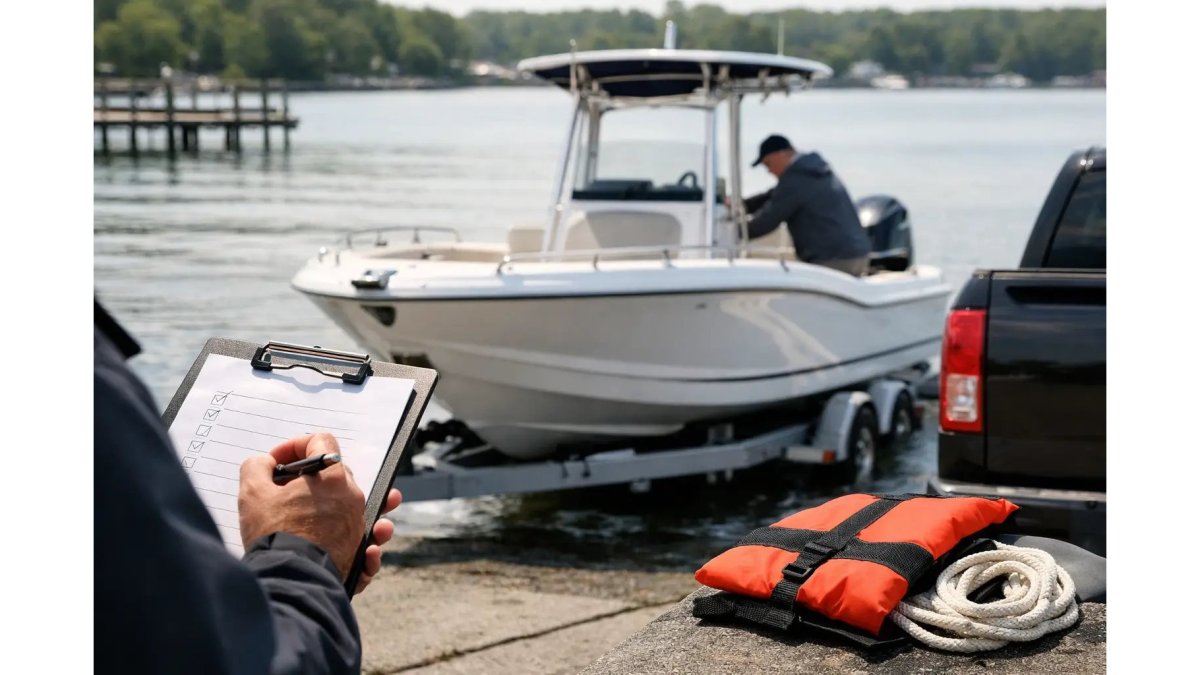
Affordable marine gear for center consoles starts with safety, lighting, and corrosion protection. Compare real prices and find gear that fits your layout.